Project
Trajectory Embedding Learning for Subspace Clustering
A research-heavy bachelor thesis on motion segmentation that re-examined benchmark methodology and introduced an attention-based architectural extension.
July 20251 min readPython · PyTorch · Numpy · Typst
Overview
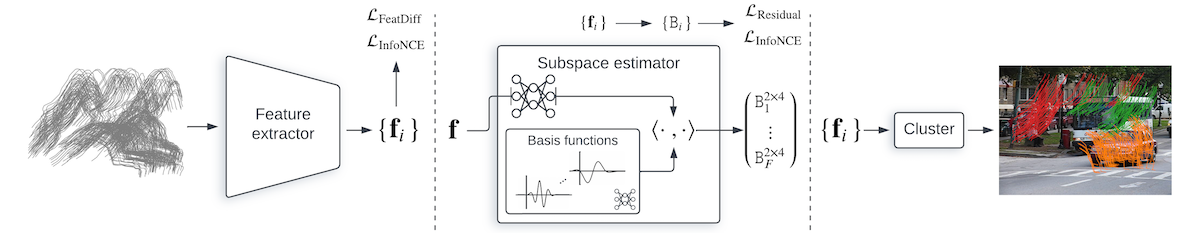
This project is a Bachelor Thesis about deep learning-based motion segmentation. It involves a faithful re-implementation of a state-of-the-art CVPR paper and addresses critical flaws in existing evaluation protocols. The thesis introduces a reproducible evaluation framework, extensive ablation studies on data augmentation, and a novel Cross-Trajectory Attention mechanism.
The Problem with Benchmarks
A deep dive into the standard Hopkins155 dataset revealed significant issues: data leakage due to parent-child sequence relationships and a high volume of stationary points. To solve this, I designed a strict 'Parent-Wise Splitting' protocol and a cross-validation strategy, proving that naive splitting significantly overestimates model generalization.
Technical Implementation
Implemented in Python using PyTorch. The architecture consists of a 1D-CNN feature extractor and a custom Subspace Estimator that learns basis functions to represent motion. The project utilizes Weights & Biases (wandb) for tracking hundreds of experiments and Bayesian optimization for hyperparameter tuning.
Novel Contributions: Attention & Augmentation
I investigated the impact of SimCLR-inspired augmentations (shifting and occlusion) on unsupervised learning. Furthermore, I extended the architecture by integrating a Transformer Encoder to enable cross-trajectory attention. This allowed trajectories to 'communicate' and exchange motion information, resulting in a statistically significant performance improvement (p < 0.0001) compared to the base architecture.